Showing posts with label Mortgage Rates. Show all posts

Wednesday, December 14, 2011

Mortgage refinance demand jumped last week: MBA

As rates just barely dip under 4%.
Applications for refinancing on home mortgages jumped last week, even as demand for new home purchases dried up, an industry group said on Wednesday.
The Mortgage Bankers Association said its seasonally adjusted index of mortgage application activity, which includes both refinancing and home purchase demand, rose 4.1 percent in the week ended Dec 9.
The MBA's seasonally adjusted index of refinancing applications climbed 9.3 percent, while the gauge of loan requests for home purchases tumbled 8.2 percent.
The refinance share of total mortgage activity rose to 79.7 percent of applications from 76.0 percent the week before.
Fixed 30-year mortgage rates averaged 4.12 percent, down 6 basis points from 4.18 percent the week before. It was the lowest rate this year, MBA said.
The survey covers over 75 percent of U.S. retail residential mortgage applications, according to MBA.
Link Here

Tuesday, November 8, 2011

Nearly 29% of mortgaged homes underwater, report finds

Were are slowly getting closer to 1 out of every 3 homes with a mortgage.
The rising percentage of homes with "negative equity" or "underwater" status is due largely to how long the foreclosure sale process takes rather than home value fluctuations, said Zillow chief economist Stan Humphries. Prior to the "robo-signing" scandal around foreclosures that came to light in 2010, the negative equity rate hovered in the 21 to 23 percent range, but has been in the 26 to 28 range since due to added delays in foreclosure sales. While the rate of foreclosures is dropping, the time required for foreclosures to sell has lengthened.
"We're in uncharted waters," Humphries said in an interview. "More than one in four homes underwater and about 9 percent unemployment is a recipe for more foreclosures."
And look at this.
The survey, by Columbus, Ohio-based Home Value Insurance Co., found that one-third of respondents thought buying a home was a risky investment and 18 percent said they were "not sure" they'd advise a younger person to buy one. About 85 percent said they consider now a bad time to sell but a good time to buy, while 23 percent of owners said they were likely to sell within five years.
Who are they going to sell their homes to? And how and they going to have income and a down payment to buy them?  This is going to put a lot of pressure on home prices.

Link Here 

Monday, October 24, 2011

Obama administration ramps up mortgage refinancing effort

HARP, which launched in March 2009, helped 838,000 Fannie Mae and Freddie Mac borrowers with loan-to-value ratios between 80% and 125% refinance. But roughly 7% of those held LTVs above 105%.
In order to assist more of the estimated 11 million borrowers who owe more on their mortgage than their home is worth, the FHFA removed the 125% LTV ceiling on the program.
And....
Underwater borrowers can't qualify for new loans or refinancings even if they are current on payments. And many would-be buyers are sitting on their hands, spooked by the high numbers of foreclosures and vast tracts of vacant homes.
In the meantime, banks are stepping up efforts to foreclose on borrowers in default. In the three months that ended Sept. 30, notices of default, the first formal step in the foreclosure process, jumped nearly 26% from the previous quarter, according to DataQuick, a San Diego real estate information service.
Even with this plan there still will be a large shadow inventory out there
And even with changes, the program won't do anything for the 3.5 million homeowners who are at least 120 days late on their payments or in default.
The administration is working on another plan that could convert a large number of vacant homes to rental properties. The effort, floated by Fed officials and people in the housing industry, could reduce the number of empty houses that are blighting communities.
With demand for rental housing relatively strong, small investors have been buying foreclosures and other homes to turn them into rentals. But Fed Gov. Elizabeth Duke said at a recent forum that large-scale conversions haven't happened because it's expensive to manage single-family home rentals and that the standard practice for the government and the industry has been to prepare vacant properties for sale to new homeowners.
Read it all

Thursday, October 20, 2011

Mortgage applications plummet 14.9%

The number of mortgage applications filed in the United States plunged 14.9%, according to an industry trade group.
The Mortgage Bankers Association said Wednesday that its market composite index – a measure of mortgage application volume – fell 14.9% from the previous week on a seasonally adjusted basis.
Meanwhile, the refinance index fell 16.6% from the previous week, and the seasonally adjusted purchase index declined 8.8% from a week earlier.
The conventional purchase index fell 11%, while the government purchase index declined 5.9%.
On an unadjusted basis, the government purchase index grew 3.3% year-over-year and was the only index to grow over last year. The government share of purchase activity increased in the past three weeks to an index score of 43.5, the highest since April.
Home refinancing activity fell this past week with refi applications representing only 77.6% of all mortgage filings, compared to 79.1% a week earlier.
The MBA report found purchase

Thursday, October 13, 2011

Southland Home Sales Up – Barely – from Year Ago, Median Price Dips Again

Let's cut straight to the chart.

Sales Volume Median Price
All homes Sep-10 Sep-11 %Chng Sep-10 Sep-11 %Chng
Los Angeles    6,070 6,185 1.90% $340,000 $310,000 -8.80%
Orange         2,524 2,510 -0.60% $445,000 $425,000 -4.50%
Riverside      3,292 3,303 0.30% $200,000 $191,000 -4.50%
San Bernardino 2,454 2,295 -6.50% $160,000 $150,000 -6.30%
San Diego      3,069 3,084 0.50% $330,500 $315,000 -4.70%
Ventura        682 772 13.20% $370,000 $349,000 -5.70%
SoCal          18,091 18,149 0.30% $295,500 $280,000 -5.20%

And look at the median and higher end markets.

The focus for many buyers continues to be on the region’s most affordable resale homes, often located in areas hit hardest by distressed property sales and price declines. Compared with a year earlier, September home sales fell in the middle and upper price ranges but rose 5.6 percent in the below-$300,000 market. Sales of homes priced $300,000 to $800,000 fell 9.3 percent year-over-year, while sales over $800,000 fell 10.4 percent from September 2010.
Only sales below $300,000 median price where strong.  And look at the financing activity

The typical monthly mortgage payment that Southland buyers committed themselves to paying was $1,084 last month, down from $1,101 in August and down from $1,177 in September 2010. Adjusted for inflation, current payments are 53.4 percent below typical payments in the spring of 1989, the peak of the prior real estate cycle. They are 61.9 percent below the current cycle’s peak in July 2007.
Read it all

Jump in mortgage rates: Bankrate

Mortgage rates climbed this week after investors became less pessimistic about the financial crisis in Europe and the employment market in the United States. But rates remain near all-time lows and are expected to stay at those levels at the expense of the economy. 
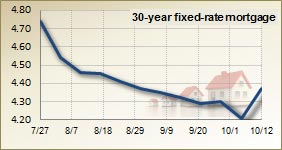
30 year fixed rate mortgage – 3 month trend
30 year fixed rate mortgage – 3 month trend 

The benchmark 30-year fixed-rate mortgage rose 16 basis points this week, to 4.37 percent, according to the Bankrate.com national survey of large lenders. A basis point is one-hundredth of 1 percentage point. The mortgages in this week's survey had an average total of 0.4 discount and origination points. One year ago, the mortgage index was 4.47 percent; four weeks ago, it was 4.32 percent. This is the highest the 30-year fixed has been since Aug. 31, when it was 4.37 percent. 
The benchmark 15-year fixed-rate mortgage rose 13 basis points, to 3.59 percent. The benchmark 5/1 adjustable-rate mortgage rose 15 basis points, to 3.26 percent, and the jumbo 30-year fixed rose 8 basis points, to 4.9 percent
This is the key analysis from Bankrate.
The upward trend is not expected to last. The rate on 30-year fixed mortgages isn't expected to rise beyond 4.5 percent until late 2012, according to the MBA's forecast. Of course, a shift in the economy or any major event that affects the global markets could change that projection in minutes.

Wednesday, October 12, 2011

Mortgage applications increase 1.3%

Expect very different news next week.
Mortgage application filings increased 1.3% this past week as refinance and purchase activity picked up, an industry trade group said Wednesday.
The Mortgage Bankers Association reported that the market composite index – a measure of loan application volume – jumped 1.3% on a seasonally adjusted basis from last week.
The refinance index also edged up 1.3%, while the purchase index grew 1.1% over a week ago.
The increases in both categories were driven by government loans, the MBA said.
The government purchase index alone shot up 2.4%.
The refinance share of mortgage activity remained unchanged overall, representing 79.1% of all activity.
In terms of interest rates, the adjustable-rate mortgage fell to 6% from 6.4% of total applications.
The 30-year, FRM increased to 4.25% from 4.18%, while the 30-year, FRM on jumbos increased to 4.59% from 4.49%. The 30-year fixed backed by the FHA grew to 4.06% from 4.05%, while the 15-year FRM increased to 3.53% from 3.49%. The 5/1 ARM increased to 3.03% from 3.02%.
The average loan size in the U.S. hit $210,863, down from $212,736 in August.
The average loan in refinancing was valued at $237,632, compared to $241,323 a month ago.
Read it all

Thursday, October 6, 2011

Rate on 30-year mortgage falls to record 3.94 pct.

The average rate on the 30-year fixed mortgage fell to 3.94 percent this week, the lowest rate ever. For those who can qualify for the historically low rate, it's an extraordinary opportunity to buy or refinance.
Freddie Mac says the average rate on a 30-year fixed mortgage dropped from 4.01 percent last week, the previous low. The average rate on a 15-year fixed loan dipped to 3.26 percent, also a record.
Low rates have done little to boost home sales or refinancing. Many people don't have enough cash or home equity to get a loan, or they are reluctant to take the risk in this market. Others have already refinanced
Link Here

Wednesday, October 5, 2011

Mortgage applications drop 4.3%

Mortgage applications fell 4.3% in the most recent week even as mortgage rates retained their lowest levels since the 1940s.
The Mortgage Bankers Association noted the market composite index – a measure of mortgage loan application volume – declined 4.3% as interest rates continued to fall on the fact the Federal Reserve is investing in longer-term Treasury and mortgage securities.
The refinance index fell 5.2% from the previous week, while the index of loan purchases fell a slight 0.8%.
Meanwhile, the unadjusted purchase index fell 1.7% compared with the previous week and was 12.1% lower than the same week last year
Read it all

Thursday, September 29, 2011

Rate on 30-year mortgage falls to record 4.01 pct.

These advertise rates may not be the real rates most borrowers are getting when their loans are finally approved.  Some borrowers are getting charged a lot of points.
Fixed mortgage rates have fallen to historic new lows for a fourth straight week and are likely to fall further.
The average on a 30-year fixed mortgage fell to 4.01 percent this week, Freddie Mac said Thursday. That's the lowest rate since the mortgage buyer began keeping records in 1971. The last time long-term rates were lower was in 1951, when most long-term home loans lasted just 20 or 25 years.
The average on a 15-year fixed mortgage, a popular refinancing option, ticked down to 3.28 percent. Economists say that's the lowest rate ever for the loan.

Contracts to buy homes fell 1.2 percent in August

WASHINGTON (AP) -- The number of Americans who signed contracts to buy homes fell in August, after a weaker-than-expected peak buying season.
The National Association of Realtors said Thursday that its index of sales agreements fell 1.2 percent last month to a reading of 88.6
A reading of 100 is considered healthy. The last time the index reached that level was in April 2010, the final month that buyers could qualify for a federal tax credit that has since expired.
Contract signings are usually a reliable indicator of where the housing market is headed. There's typically a one- to two-month lag between a contract and a completed deal.
But the Realtors group said a growing number of buyers have canceled contracts after appraisals showed the homes were worth less than the buyers had bid. A sale isn't final until a mortgage is closed.
Home loans are also harder to come by. Many lenders are requiring 20 percent down payments and strong credit scores to qualify.
The pace of sales for previously occupied homes is slightly above last year's 4.91 million sold, the fewest since 1997. In a healthy economy, Americans would buy roughly 6 million homes each year.
In August, sales of new homes fell for a fourth straight month. This year is shaping up to be the worst for new-home sales on records dating to 1963.
Even so, homes are the most affordable they've been in decades. Mortgage rates are at six-decade lows. Prices in some metro areas have been cut in half. Still, sales in most areas remain weak.
The number of people signing home contracts rose in both May and June. But those increases didn't make up for a huge drop-off in April, when signings fell more than 11 percent. Over the past two months, signings have declined 2.5 percent.
Contract signings fell across most of the country. July's index fell 5.8 percent in the Northeast, 3.7 percent in the Midwest and 2.4 percent in the West. It rose 2.6 percent in the South.
Link Here

Wednesday, September 28, 2011

Super low mortgage rates are hard to get

“We’re seeing about an eighty-four basis point difference between the average rate and lowest rates offered, the largest spread since LendingTree began tracking the data," says Doug Lebda, LendingTree's CEO. "That’s about a $125 difference in monthly mortgage payments on an average home loan, or $1,500 per year that borrowers could be saving on their mortgage payments." 
 Why are the spreads widening?
My guess is it's all about the credit quality, or lack thereof, of today's borrowers.
There are just a huge number of people who are unable to qualify for super low rates, so when lenders see really qualified borrowers, perhaps they're willing to offer them a better rate because that loan is so much more desirable. A borrower with good credit will find an increasingly competitive rate landscape.
Read it all

Monday, September 26, 2011

What New Jumbo Mortgage Rules Mean for Expensive Zip Codes

On Oct. 1, the size of mortgages eligible for purchase by Fannie Mae and Freddie Mac will shrink. That isn't necessarily a big deal in most parts of the country; the new lower limit of $625,500 — down from today's $729,750 — still is big enough to cover most homes in almost all markets in the United States.
Furthermore, mortgage bankers are stepping up with new money to cover those bigger loans, reports Mortgage Daily. "Programs here and there are popping up," says publisher Sam Garcia. He reports that some new lenders, including TMS Funding and New Penn Financial LLC, are launching programs that will make mortgages as big as $2 million available to lenders with good credit scores and enough cash to keep up with the payments. And many existing mortgage lenders currently will make those so-called "jumbo" loans and just keep them in their portfolios instead of selling them.
But those loans will cost more. Currently the difference between rates on so-called conforming loans and private-made loans is about 0.64 percent. Over the last two years that spread has been as low as 0.48 percent and higher than one percent, says Garcia.
So in some pricey places, the new limits will really pinch borrowers. Those limits vary from market to market and are determined in part by local housing prices. In expensive housing markets where prices have fallen, the limits will drop the most. Hardest to be hit, according to a new analysis by Move.com, will be San Diego, where loans up until $697,500 qualify for Fannie and Freddie until Sept. 30. On Oct. 1, that limit drops to $546,250, a $151,250 difference.

Friday, September 23, 2011

FHA loans have the most fees and are the costly loans

What this article left out is that the default rate on these loans are high, so mortgage insurance portion must be increased to cover the costs of these defaults.
"Like the conventional universe, the 4.5% coupon has now moved completely into the 40bp refinancing window," said Scott Buchta, managing director at Sandler O'Neill. "Higher (mortgage insurance) fees and a lack of a HARP-like program may prevent some FHA borrowers from refinancing."
There is strong possibility that most of these FHA borrower will strategically default.

Read it all

Wednesday, September 21, 2011

Mortgage applications tick up slightly as refinancing activity grows

Much of the limited positive activity was driven by homeowners refinancing existing loans. The refinance index grew 2.2% over the previous week, while the seasonally adjusted purchase index fell 4.7% from a week earlier.
The MBA report says the refinancing share of mortgage activity in the U.S. represented 78.3% of all applications filed, compared to 76.8% a week earlier. The ARM share of activity fell from 7.3% to 6.7%.
The MBA released new data showing investors represented 5.7% of all homes purchased in August, up from 5.5% in July. New investor activity in the Pacific region also drove the increase, the MBA said.
Read it all

Monday, September 19, 2011

Obama looks to increase Fannie and Freddie guarantee fees

As posted earlier.  And how is he going to do this?
Jim Vogel with FTN Financial studied the plan and found the administration wants a 10-basis point increase in guarantee fees at Fannie Mae and Freddie Mac by next year. He added, the "FHFA is going to look for creative ways to gradually raise fees in 2012 with a combo of fewer discounts, geographic differentiation, and a reduction of cross-product subsidies." The Treasury Department believes the change could result in savings of $28 billion over a period of 10 years.
This have impact on the mortgage of the loan obtain by the borrower, 10 basis points is .1% mortgage rate increase.  
Read it all

Fannie Mae and Freddie Mac raising loan guarantee fees

According to Diana Olick at CNBC, the FHFA Director will raise the loan guarantee fees that both Fannie Mae and Freddie Mac charge.  When a loan is backed by Fannie Mae or Freddie Mac and it defaults, then Fannie or Freddie Mac must compensate the investor that purchase the loan.  If too many loans fail then Fannie and Freddie start losing money and therefore the tax payers lose money, since 79.9% of both companies are owned by the Federal government.  This increase in fees will keep the bill off the taxpayers, so what would happen in 100% privately ran system.

It is believed that both companies will eventually go back to being 100% private.  And the loan guarantee by the US government will decrease or disappear entirety.  This will have the affect of raise the mortgage rates, which is what FHFA is trying to do.

Thursday, September 15, 2011

Rate on 30-year mortgage falls to record 4.09 pct.

WASHINGTON (AP) -- Fixed mortgage rates fell to the lowest level in six decades for the second straight week. But few Americans can take advantage of the historically low rates.
Freddie Mac says the average rate on the 30-year fixed mortgage fell to 4.09 percent this week. That's the lowest rate seen since 1951.
The average rate on the 15-year mortgage, a popular refinancing option, fell to 3.30 percent, also a new low. Economists say it is likely the lowest rate on the 15-year ever.
Mortgage rates tend to track the yield on the 10-year Treasury note. Worries over Europe's debt crisis are pushing investors to shift money into safe Treasurys, forcing the yield lower.
Still, the cheap mortgage rates haven't helped home sales. Few would-be buyers can meet stricter loan requirements.
Link Here

Wednesday, September 14, 2011

Mortgage applications up 6.3% last week

Mortgage applications rose 6.3% last week as more homeowners filed purchase applications and refinanced their home loans.
The Mortgage Bankers Association said its refinance index increased 6% last week after three weeks of declines.
The trade group said the refinance index is not seasonally adjusted but does include an adjustment for Labor Day. On an unadjusted basis, refinancings fell 15.2% and are down 23.5% from a year earlier.
The purchase index climbed 7% from a week prior, while the unadjusted purchase index fell 16.2%. The unadjusted overall composite index decreased 15.4% from the prior week.
The refinance share of mortgage activity represented 77.3% of total applications, compared to 77.1% a week earlier.
The MBA said the average interest rate for a 30-year fixed mortgage slid to 4.17% last week from 4.23% a week prior. The average rate for a 15-year fixed mortgage inched down to 3.4% from 3.41
Link Here

Tuesday, September 13, 2011

Q2 Negative Equity Declines in Hardest Hit Markets: CoreLogic

Q2 negative equity data showing that 10.9 million, or 22.5 percent, of all residential properties with a mortgage were in negative equity at the end of the second quarter of 2011, down very slightly from 22.7 percent in the first quarter. An additional 2.4 million borrowers had less than five percent equity, referred to as near-negative equity, in the second quarter. Together, negative equity and near-negative equity mortgages accounted for 27.5 percent of all residential properties with a mortgage nationwide. The new report also shows that nearly three-quarters of homeowners in negative equity situations are also paying higher, above-market interest on their mortgages.
This means there is a lot more potential for people to walk away from their loans.  Especially if they are paying a higher interest rate on the loan.
Read it all